By Juan Herbozo Echevarría
A Business Central user opens a support ticket because a sales order is still pending even though the warehouse says the goods have been picked. An assistant can explain how to find posted shipments. An authorized agent can look up the order, check which quantities have shipped, and attach evidence to the ticket to support its diagnosis.
If the user asks the agent to post the shipment, the nature of the decision changes. Picking goods and confirming that they have left the warehouse are two different events. Before anything is posted, someone needs to verify what happened and who can authorize the operation.
What MCP brings to the integration
For years, connecting applications to enterprise systems has meant building and maintaining custom integrations. The Model Context Protocol (MCP) gives AI applications a common interface for discovering and calling tools exposed by a server. The APIs and business logic still sit behind those tools. The organization decides which operations to expose and how narrowly to scope them.
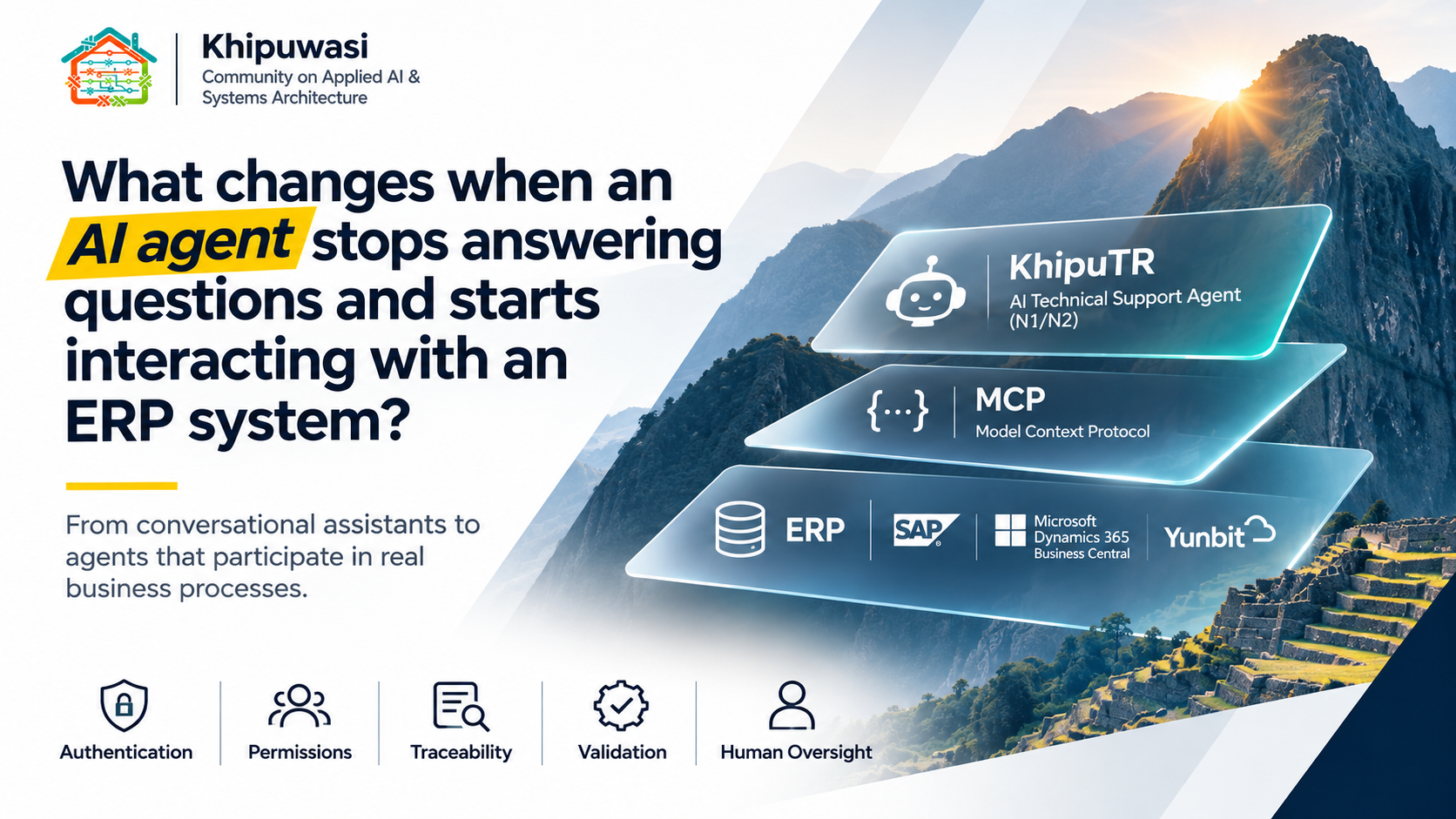
SAP documents how to expose enterprise APIs as tools through SAP Integration Suite. Microsoft offers an MCP server for Business Central online whose default configuration supports read-only discovery and access to eligible APIs within the user’s permissions. Yunbit has announced that it developed MCP servers to connect customers’ own agents to its ERP. SAP Help Portal · Microsoft Learn · Yunbit announcement in Spanish
What I would delegate to a support agent
| Operation | Autonomy I would grant |
|---|---|
| Look up the order and its posted shipments | Automatic, with read permissions scoped to the authorized company and environment. |
| Add an internal note to the support ticket | Automatic if the ticket is identified and the note cites the documents that support the diagnosis. |
| Post a shipment in production | Explicit approval from an authorized person who can see the order and quantities before confirming. |
Enforce controls where the operation runs. The service receiving the request should identify the user, check their permissions, and validate the order and quantities at execution time. Someone else may have posted the shipment between the recommendation and the approval. If the request is interrupted and the outcome is uncertain, the agent should check the ERP state before retrying. The ticket should record what was requested, who approved it, and the resulting document where applicable.
How I’m exploring this with KhipuTR
KhipuTR is the N1/N2 technical support agent I’m designing as part of Khipuwasi. I want it to retrieve technical knowledge, compare it with evidence from the case, and prepare a diagnosis that a support technician can review. From there, the agent could gradually take on specific actions, starting with those whose results are easy to verify.
Before adding an action, I would ask three questions. What can the agent do? Under what conditions can it do it? What evidence will confirm the result? A diagnosis can cite the documents the agent consulted. Posting a shipment calls for checking the resulting document and its effects in the ERP.
Which operation would you delegate to an agent in your ERP today, and which would you still reserve for an authorized person?